
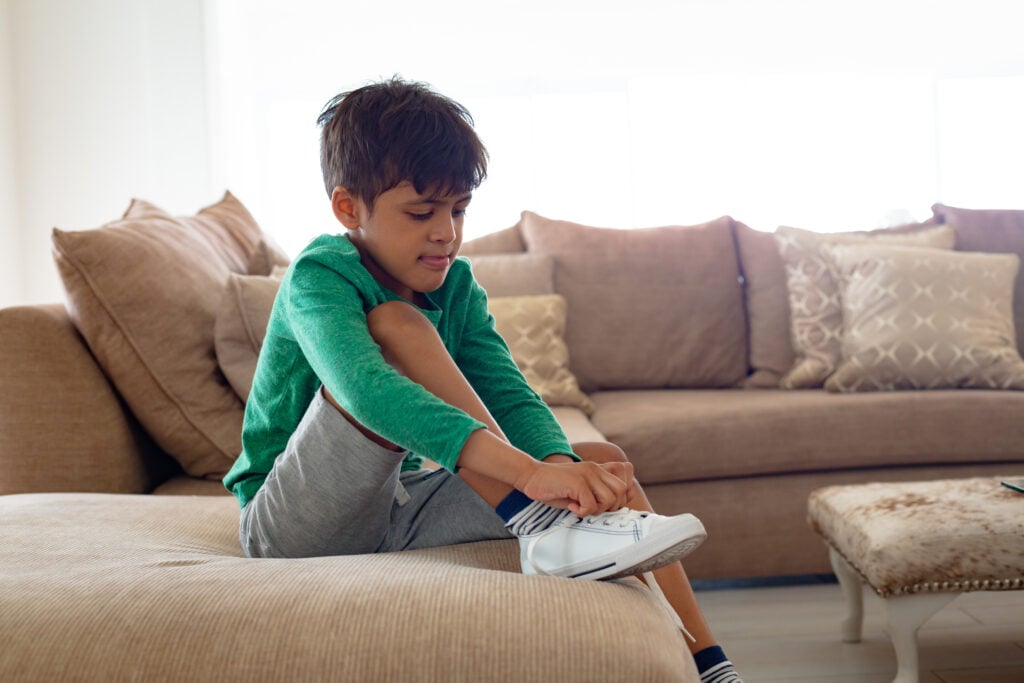
It’s time to get ready for school, and somehow putting on a shirt has become the hardest part of the morning.
Maybe your child puts their clothes on backward, struggles with buttons and zippers, or needs help getting their arms and legs into the right places. Maybe they can get dressed independently, but it takes so long that you’re tempted to step in and do it yourself.
Getting dressed might seem like one basic task, but your child actually uses many different skills to do it independently. If one or more of those skills is still developing, dressing can be much harder than it looks.
What Skills Does My Child Need to Get Dressed?
Think about everything that happens when your child puts on a pair of pants. They have to figure out which way the pants go, maintain their balance, coordinate both hands, guide each foot through the correct opening, pull the pants up, and adjust them once they’re on. Your child needs:
Fine motor skills – small, precise movements your child makes with their hands and fingers.
Bilateral coordination – using both sides of the body together in a coordinated way.
Balance and coordination – to control their body as they move through the different steps of getting dressed.
Body awareness – your child’s understanding of where their body is and how its different parts are positioned.
Visual skills – to recognize the front and back of clothing, find openings, line up buttons with buttonholes, and see whether their clothes are positioned correctly.
All of these skills work together to help your child figure out what to do, in what order, and how to make their body do it. And that’s before we even get to figuring out how to use buttons, snaps, shoelaces, and zippers!
Why Is Getting Dressed So Hard for My Child?
Different children can struggle with dressing for different reasons.
A child who has difficulty with fine motor skills might have trouble fastening small buttons or pulling up a zipper. A child working on balance may struggle to stand while stepping into pants. Another child might have difficulty remembering which clothing item comes next or figuring out how to position their body to get into it.
That’s why it’s helpful to look beyond “My child won’t get dressed” and pay attention to which part of getting dressed seems difficult.
When Should My Child Be Able to Dress Independently?
Dressing skills develop gradually rather than appearing all at once.
Young children typically begin by helping with simple parts of the process, such as pushing an arm through a sleeve or taking off easy-to-remove clothing. Over time, they learn to pull clothing on and off, manage fasteners, choose the correct orientation, and complete more of the dressing routine without help.
Some parts of dressing take longer to master than others. Tying shoelaces, for example, requires considerably more coordination than pulling on an elastic-waist pair of pants.
Instead of comparing your child with another child of the same age, consider whether they’re gradually becoming more independent and whether dressing difficulties are interfering with everyday routines.
How Can Occupational Therapy Help My Child Get Dressed?
Getting dressed is an activity of daily living, or an everyday self-care skill. Helping children become more independent with these activities is an important part of pediatric occupational therapy.
An occupational therapist can look at which part of dressing is challenging for your child and the skills involved. Depending on your child’s needs, therapy might work on fine motor control, hand strength, balance, coordination, body awareness, motor planning, or sensory processing.
Your child’s therapist can also break a complicated dressing routine into smaller, more manageable steps and help you find strategies that work for your family at home.
Building Independence One Step at a Time
Learning to get dressed independently gives your child more than a smoother morning routine. It’s an opportunity to build confidence, practice problem-solving, and take greater responsibility for their own everyday needs.
If getting dressed is consistently difficult or frustrating for your child, the pediatric occupational therapists at Building Futures can help identify the skills they need extra support developing. Through individualized, play-based therapy, we’ll work with your child and family to make everyday routines more manageable and help your child become more independent.