
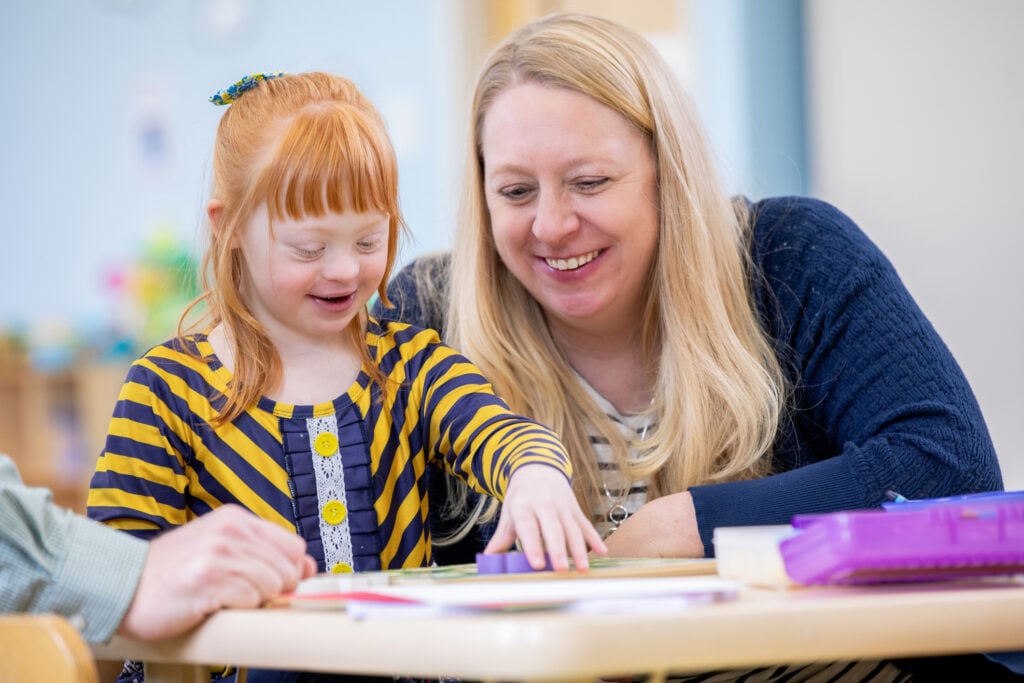
Every child has things they want to do more independently, whether that’s getting themselves ready in the morning, participating in school, playing with friends, or helping with everyday tasks at home.
For children with Down syndrome, occupational therapy can provide extra support while they develop the skills they use for these activities. What that looks like will be different for every child, depending on their age, strengths, needs, and goals.
Here are five areas an occupational therapist can work on with your child.
Fine Motor Skills
Fine motor skills are the small, controlled movements your child makes with their hands and fingers.
Children with Down syndrome can have low muscle tone, or hypotonia, as well as differences in strength and coordination that can make some hand movements more challenging. An occupational therapist can help your child build the skills they use to pick up and manipulate small objects, hold crayons and utensils, use scissors, turn knobs, and manage buttons or zippers.
For younger children, therapy might look like stacking blocks, playing with toys, scribbling with crayons, or picking up small objects. As your child grows, these same underlying skills can support handwriting, dressing, school activities, and other everyday tasks.
Dressing, Feeding, and Other Self-Care Skills
Occupational therapists help children develop activities of daily living, or the everyday self-care tasks they need to become more independent.
For your child, that might mean learning how to put on a shirt, pull up their pants, fasten clothing, brush their teeth, wash their hands, use the bathroom, or feed themselves.
An occupational therapist can break a complicated activity into smaller steps, help your child practice the skills involved, and recommend adaptations when needed. The goal is to give your child the support and practice they need to participate more actively in caring for themselves.
Sensory Processing
Sensory processing is how your child’s brain receives, organizes, and responds to information from their senses.
Some children with Down syndrome have sensory differences that affect everyday activities. Your child might dislike certain textures, frequently put objects in their mouth, use more or less force than a task requires, or have difficulty recognizing where their body is in space.
An occupational therapist can look at how your child’s sensory needs are affecting their daily life and help your family find strategies that make activities easier to participate in.
School Skills
Going to school involves a whole collection of skills beyond understanding what’s being taught.
Your child may need to hold and control a pencil, cut with scissors, manipulate classroom materials, sit comfortably at a desk, organize their belongings, and move through daily classroom routines.
Occupational therapy can support the motor, visual, sensory, and organizational skills your child uses at school. An OT can also recommend adaptations to your child’s activities or environment when needed to make participating in the classroom more accessible.
Play Skills
Play gives children opportunities to explore their environment, connect with other people, and practice new skills.
Building with blocks, completing puzzles, pretending with toys, drawing, opening and closing containers, and playing games can help children practice motor skills, problem-solving, coordination, and interacting with others.
An occupational therapist can use activities your child enjoys to help them develop new skills through play. Therapy can also support the skills your child needs to participate in play with siblings, classmates, and friends.
Helping Your Child Become More Independent
Occupational therapy can help your child develop skills that make it easier to participate in the activities that matter to them.
At Building Futures, our pediatric occupational therapists work with children and their families to identify the activities that are important to them and the skills that need extra support. Through individualized, engaging therapy, we can help your child build confidence and independence at home, at school, and at play.
to your child.