
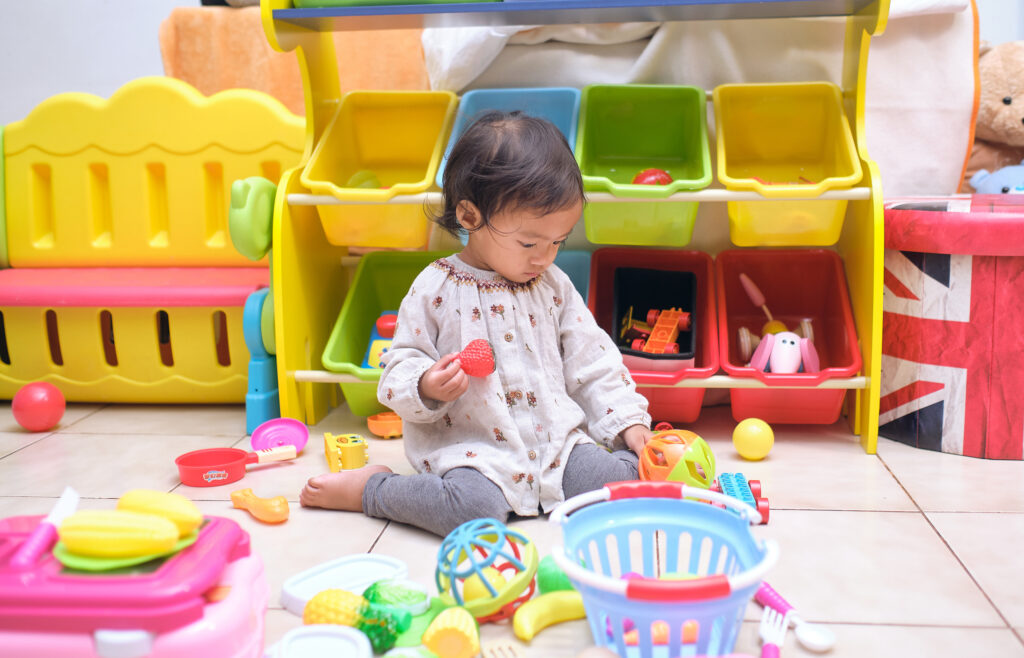
Your child settles on the floor with a puzzle, knees bent in front and feet out to each side of their hips. Someone notices and says, “You should have them sit another way. It’s not good for their hips.” Suddenly, a position you barely thought about has you wondering whether it could harm your child or affect how they move.
This position is called W-sitting, and parents have heard conflicting advice about it for years. If it’s your child’s preferred way to sit, take heart: W-sitting alone usually isn’t a reason to worry. What matters more is whether your child moves comfortably in other positions and can participate in the activities they enjoy.
What Is W-Sitting and Why Do Children Do It?
When your child W-sits, they sit on the floor with their knees bent in front of them and their lower legs angled out on either side. Look down from above, and their legs form the shape of a W. It is different from sitting criss-cross, with both legs folded in front.
For many children, W-sitting is simply a comfortable way to play. Their legs provide a wide, steady base while they reach for toys, turn pages, or concentrate on an activity. Some children’s hips also rotate inward more easily, making this position feel natural to them. This inward turn is normal for many young children and usually lessens as they grow.
What Experts Know About the Effects of W-Sitting
You may have heard that W-sitting can damage your child’s hips or cause lasting changes in their legs and joints. But has W-sitting itself been shown to cause any of these?
What the Research Says
A 2020 study published in Clinical Pediatrics compared hip X-rays of children who W-sat with those of children who did not. Children who W-sat were no more likely to have hip dysplasia, a condition in which the hip joint does not develop as expected.
A 2024 review of the available research found no evidence supporting a general rule against W-sitting or linking it to other bone or joint changes. The research is limited, but it does not support treating W-sitting alone as a reason for concern.
Why Pediatric Therapists Still Pay Attention to W-Sitting
Some children prefer W-sitting because it gives them extra stability. That can be especially true for children with low muscle tone (muscles that feel looser and take more effort to hold the body upright) or very flexible joints. When a child sits this way nearly all the time, a therapist may wonder whether other positions feel harder to hold. The position itself isn’t the concern. A child’s difficulty using other positions may tell a therapist more about how they move during play.
How to Encourage Different Sitting Positions During Play
Children naturally change positions as they play. Your child might sit criss-cross for a story, stretch their legs out for a game, sit to one side while reaching for a toy, and W-sit while building with blocks. Moving between positions helps your child practice balance and shifting their weight, so variety is worth encouraging without making W-sitting off-limits.
You can help by:
- Reading together on the floor: Sit with your legs stretched out and invite your child to do the same.
- Placing toys to one side: Give your child a reason to turn toward a toy or game piece and shift their position as they play.
- Building a tower together: Sit criss-cross facing your child and invite them to do the same as you take turns adding blocks to a tower between you.
- Making it a game: Take turns trying playful poses, such as sitting like a mermaid with legs curled to one side or stretching your arms and legs out like a starfish, and see which ones your child enjoys.
What if Your Child Can Only Sit Comfortably While W-Sitting?
If your child always returns to W-sitting, notice what happens when they try another position. Can they sit with their legs in front or to one side? Can they shift their weight to reach a toy and get up from the floor without difficulty?
It may be worth talking with a pediatric occupational or physical therapist if your child:
- Seems uncomfortable whenever they sit in another position
- Has trouble changing positions while playing on the floor
- Experiences difficulty getting up from sitting to standing
- Avoids floor activities that require them to turn, reach, or move around
How Can Pediatric Therapy Help a Child Who Relies on W-Sitting?
An occupational or physical therapist can look at what makes other positions harder for your child and help them build more ways to move and play.
How Physical Therapy Can Help
Physical therapy focuses on big-body movement, like balance, strength, and getting up and down from the floor. A pediatric physical therapist may:
- Check strength, balance, and hip movement to understand why other positions feel harder to hold
- Watch your child move between sitting, kneeling, and standing
- Turn practice into play with animal walks, obstacle courses, and reaching games that support strength, balance, and flexibility.
How Occupational Therapy Can Help
Occupational therapy helps your child participate in everyday activities, from playing on the floor and coloring to getting dressed. A pediatric occupational therapist may:
- Observe how your child sits while they reach for toys and use their hands
- Adjust the play setup by changing where toys are placed or offering activities that invite your child to turn and shift positions
- Help your child try new sitting positions during favorite activities, like side-sitting for a card game or sitting criss-cross to color
In therapy, the goal is to make movement and play more comfortable for your child, not to forbid W-sitting.
Reach Out to Building Futures for Support
If your child only finds W-sitting comfortable, Building Futures Pediatric Therapy can help. If you’re in the Monroe, West Monroe, or Ruston, LA, area, call one of our locations or fill out our online form to schedule an evaluation.